Quick Answer
Treat flow measurement before and after precipitation as separate selection duties: once suspended solids form, the stream must be reassessed for solids concentration, settling, coating, velocity, abrasion, conductivity, and material compatibility.
The same meter technology may still fit both points in some applications, but only after the actual medium and operating envelope at each measurement point have been checked separately.
The useful starting point is the physical condition of the medium where the measurement will take place.
Why Precipitation Changes Industrial Flow Measurement
Precipitation is a process in which dissolved material forms solid particles within a liquid under controlled process conditions.
A simplified process sequence may look like this:
Process solution
→ controlled reaction and precipitation
→ suspended solids form
→ slurry develops
→ separation and washing
→ final solid material
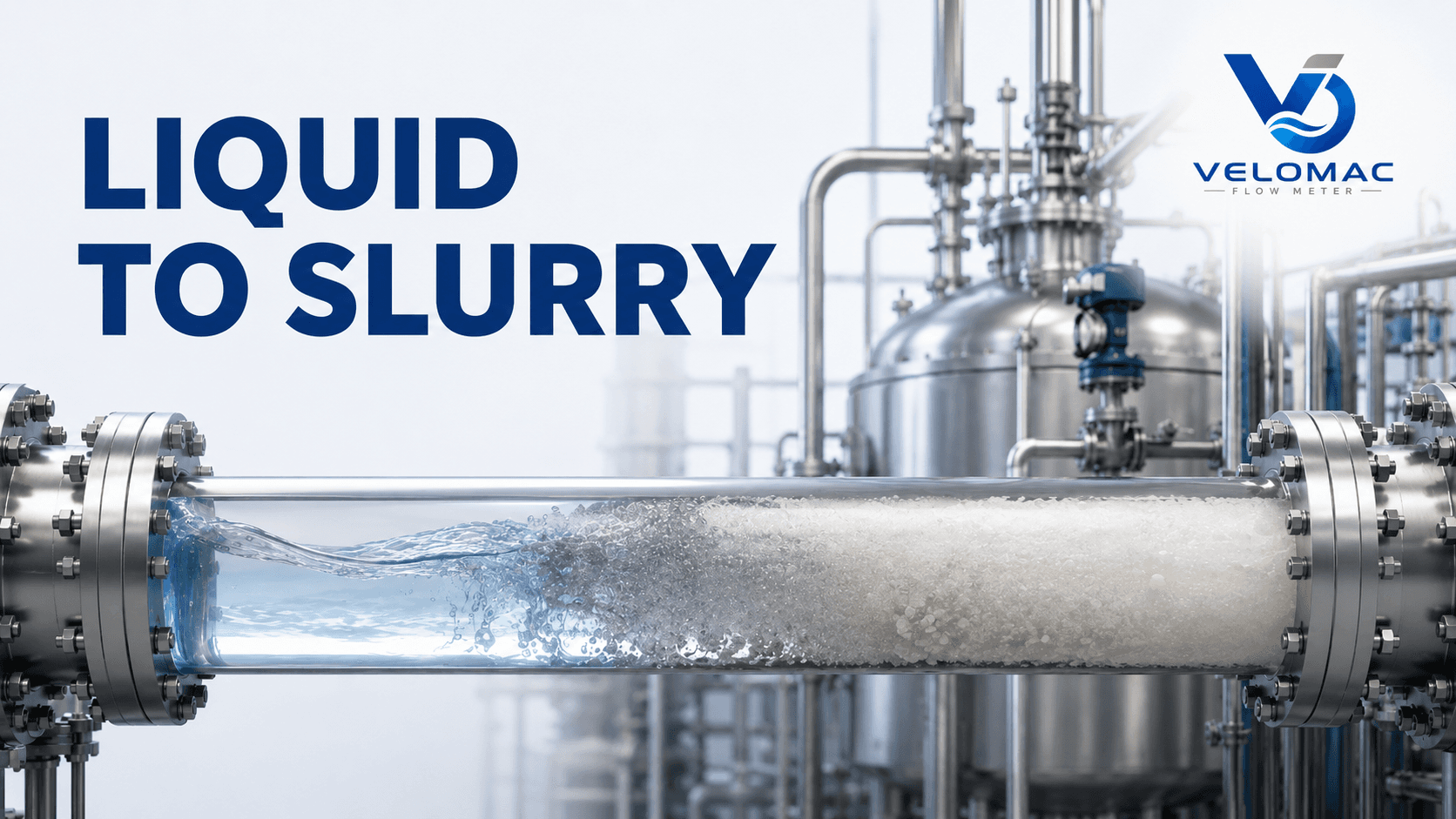
A slurry is a liquid carrying suspended solid particles. As those particles form, the measurement point may face different solids concentration, density, viscosity, particle behaviour, settling tendency, coating conditions, pressure loss, and velocity requirements.
The process line may be continuous, while the measurement conditions are no longer the same.
This means an upstream process-solution measurement and a downstream slurry measurement should each have their own selection basis.
Where Measurement Duties Change in Real Projects
One precipitation process can contain several different flow measurement jobs.
Reaction Feed
The feed point may carry a relatively uniform liquid before solids begin to form.
Engineers should define the measurement purpose, conductivity, flow range, temperature, pressure, chemical compatibility, and required control response.
Reagent Dosing
Reagent dosing has its own operating range and ratio requirements.
Minimum and normal flow may be especially important here because the dosing duty can operate far below the peak capacity of the main process line.
Process Circulation
Circulation lines may carry a developing suspension for long periods.
Velocity, solids behaviour, startup conditions, circulation flow, and settling tendency deserve separate review.
Slurry Transfer
After precipitation, the process stream may contain a higher solids load.
Solids concentration, particle behaviour, abrasion, coating, full-pipe condition, velocity, and material compatibility become central selection inputs.
Wash Water
Wash-water lines may remain clear-liquid duties even when nearby process lines carry slurry.
Their selection basis should follow the wash-water conditions rather than the adjacent slurry service.
Production Total
For material balance or production totals, teams should define exactly which stream is being totaled and what physical condition exists at that location.
Feed, dosing, circulation, slurry transfer, wash water, and production total are different measurement jobs even when they belong to one process.
What Plant Teams Should Check Earlier
Before discussing a meter model, align the process, instrumentation, EPC, commissioning, and procurement teams on three questions.
1. What is the measurement purpose?
Is the point used for reaction feed control, reagent dosing, circulation, slurry transfer, wash-water balance, or production total?
2. Where is the measurement point?
Is it before precipitation, during solids formation, or after the stream has developed into a slurry?
3. What actually passes through the pipe at that point?
Define the medium as it exists in operation: clear liquid, liquid with developing suspended solids, or slurry.
Measurement purpose + exact location + actual medium condition should be defined before flowmeter selection starts.
Build the Operating Envelope Before Selecting the Meter
One normal-flow value is not enough for a precipitation or slurry application.
Build the operating envelope around:
Minimum flow
Normal flow
Peak flow
Startup flow
Circulation flow
Cleaning or flushing flow
Pipe size
Expected velocity
Operating pressure
Operating temperature
For slurry points, compare these operating conditions with solids behaviour.
A stream that remains well suspended at normal production flow may behave differently during startup, turndown, or circulation. Lower velocity can increase settling risk, while cleaning or flushing may create a very different temporary flow condition.
The operating envelope should describe how the line actually runs, not only its design capacity.
How Physical State Affects Slurry Flowmeter Selection
Slurry flowmeter selection should be based on the medium at the exact measurement point.
Conductivity
Conductivity is an important application input when an Electromagnetic Flowmeter is being evaluated.
Use the conductivity of the actual process stream at the meter location rather than carrying over data from another part of the process.
Solids Concentration
Define the normal solids concentration and how far it can change during startup, production transitions, circulation, or other operating conditions.
Particle Behaviour
Particle size, distribution, abrasiveness, and settling tendency can change the requirements at the measurement point and the material review.
Density and Viscosity
Changes in density and viscosity can accompany slurry development and may alter the hydraulic conditions around the measurement point.
Velocity and Settling
Velocity affects both the flow measurement duty and the way suspended solids move through the pipe.
Minimum-flow conditions deserve particular attention where settling can occur.
Coating and Deposition
If the process medium can coat internal surfaces, define how quickly deposition develops, whether it changes during the production cycle, and how the line is cleaned or flushed.
Material Compatibility
Review the actual chemical composition together with temperature, solids characteristics, liner requirements, electrode requirements, and abrasive conditions.
The useful selection question is not simply “What liquid is this?” but “What physical state is the medium in at this exact measurement point?”
What Information Engineers Should Prepare
Prepare a separate application data set for each measurement point:
Measurement purpose
Exact process location
Medium description
Clear-liquid or slurry condition
Conductivity
Solids concentration
Particle behaviour
Density
Viscosity
Temperature
Pressure
Corrosiveness
Abrasive conditions
Minimum flow
Normal flow
Peak flow
Startup flow
Circulation flow
Cleaning or flushing flow
Pipe size
Expected velocity
Full-pipe condition
Settling tendency
Coating tendency
Material compatibility requirements
Required signal output
Available installation space
The feed line and the slurry-transfer line should each be reviewed from their own application data.
When an Electromagnetic Flowmeter May Be Relevant
For a conductive liquid or compatible slurry service, an Electromagnetic Flowmeter may be evaluated when the actual medium and installation conditions fit the application.
The review should include:
Conductivity
Solids concentration
Particle behaviour
Flow velocity
Full-pipe condition
Liner compatibility
Electrode compatibility
Temperature
Pressure
Coating tendency
Abrasive conditions
Required flow range
Installation space
A suitable meter at one precipitation-process point does not automatically define the meter for every other point on the same process chain.
Where solids loading, settling, coating, abrasion, chemical compatibility, or operating conditions become more demanding, that measurement point should receive its own application review.
What Velomac Usually Reviews
For chemical and slurry applications, Velomac can review the measurement purpose, medium condition, pipe size, flow range, pressure, temperature, installation space, signal requirements, and process conditions before selection.
For solids-bearing streams, the review can also include conductivity, solids concentration, particle behaviour, velocity, settling tendency, coating conditions, and material compatibility.
This keeps the selection discussion focused on the actual measurement point before a product configuration is chosen.
Practical Checklist
Before selecting a flowmeter around a precipitation process, confirm:
Where precipitation begins
Which measurement points remain clear liquid
Which points contain suspended solids
Measurement purpose at each point
Normal and maximum solids concentration
Conductivity at the actual meter location
Particle size and behaviour
Settling tendency
Minimum, normal, and peak flow
Startup and circulation flow
Cleaning or flushing conditions
Pipe size and expected velocity
Full-pipe condition
Temperature and pressure
Coating or deposition tendency
Abrasive conditions
Material compatibility
Required signal output
Available installation space
Complete this checklist separately for each measurement point instead of treating the whole precipitation process as one flow application.
Common Questions
Should the same flow measurement principle be used before and after precipitation?
Treat the two points as separate selection duties. The same principle may remain suitable only when the actual medium, solids condition, operating envelope, materials, and installation requirements at both points support it.
What is the first question in slurry flowmeter selection?
Identify the physical state of the medium at the exact measurement point. Then define the measurement purpose and full operating envelope.
When can an Electromagnetic Flowmeter be evaluated for slurry service?
An Electromagnetic Flowmeter may be evaluated for a conductive liquid or compatible slurry when conductivity, solids condition, velocity, full-pipe condition, materials, temperature, pressure, and installation requirements fit the application.
Why does minimum flow matter in a slurry line?
Minimum flow can change the way solids remain suspended. Lower velocity may increase settling risk, so minimum flow should be reviewed together with normal, peak, startup, and circulation conditions.
Does one process name give enough information for flowmeter selection?
A process name describes the broader operation. Flowmeter selection requires the medium condition, measurement purpose, flow range, pipe conditions, and installation requirements at the exact meter location.
The Measurement Point Comes Before the Meter
Process name does not select the meter. The condition at the measurement point does.
Precipitation makes this especially clear: the same production chain can contain both clear-liquid and slurry measurement duties, each with its own operating envelope and selection inputs.
If your team is reviewing a similar liquid or slurry measurement point, Velomac can check the medium condition, solids behaviour, flow range, pipe conditions, installation space, and signal requirements before selection.