Why retrofit projects need visual context
A new project may still have room to adjust pipe layout, meter location and wiring plan. A retrofit project starts with a line that already exists. The site may have limited access, nearby valves, reducers, insulation, wall clearance, support structures or no easy shutdown window. These details are difficult to understand from pipe size alone.
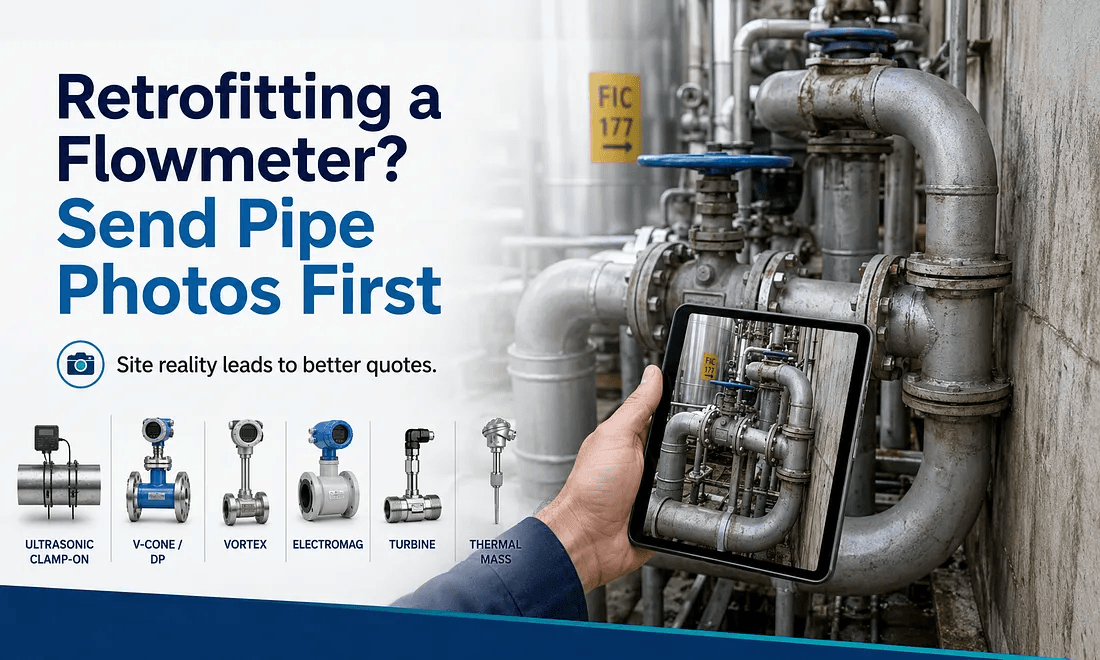
Pipe photos should be sent before the quote when the installation condition is not obvious. A drawing may show the line, but it may not show whether a technician can reach the installation point, whether the pipe can be cut, whether there is straight run, or whether vibration from nearby equipment will affect the reading. Photos make the selection discussion more grounded.
What photos can reveal before quotation
A wide photo can show upstream and downstream conditions: elbows, tees, valves, reducers, pumps, compressors, tanks, platforms and pipe supports. A close photo can show the proposed meter location, pipe surface, connection space and whether existing instrumentation or insulation may interfere with installation. Both views matter.
Photos also help identify whether a compact meter, insertion design, clamp-on ultrasonic option or differential pressure structure should be reviewed. They do not replace process data, but they prevent the supplier from assuming an ideal pipe layout that does not exist. For overseas communication, photos reduce the risk of long back-and-forth messages after the first quotation.
How photos change the meter review
If the line cannot be cut easily, a clamp-on ultrasonic flowmeter may be reviewed for suitable liquid applications. If the pipe has limited straight run, V-Cone or balanced differential pressure options may deserve attention depending on media and operating condition. If the line is steam or gas and the site has strong vibration, the vortex discussion should include installation and signal stability questions.
If the line is a conductive liquid, electromagnetic measurement may still be suitable, but the site must confirm conductivity, lining compatibility, grounding, pipe material and connection requirements. If the application is clean liquid or compatible clean gas, turbine meters may be reviewed only when the media and flow profile support that direction. Photos help decide which questions should come first.
What to send with the pipe photos
Photos are helpful, but they should be sent with process details. Include fluid name, liquid gas or steam classification, pipe size, pipe material, pressure, temperature and expected flow range. If the media is chemical liquid, include concentration and material compatibility concerns. If the media is gas, include composition and whether the gas is dry or wet. If the media is steam, include steam condition if known.
Also include power supply, signal output, local or remote display needs, quantity and any shutdown limits. If the line must stay in operation, say so. If the meter will feed a PLC or DCS, explain the required signal. If the reading supports energy review, utility allocation or process control, mention that use case so the recommendation can consider the importance of the measurement.
Common retrofit risks to review early
Retrofit projects often fail in small practical ways. The meter body may be correct, but there may not be enough space to install it. The display may face the wrong direction. The cable route may be difficult. The straight pipe may be shorter than expected. The plant may discover during commissioning that the output signal does not match the control system requirement.
These issues are avoidable when the inquiry includes field information. Velomac can review meter family, connection type, transmitter arrangement and installation notes more usefully when the buyer sends photos and site details together. The goal is not only to quote a product. It is to help the site understand whether the proposed configuration can work on the existing line.
A practical retrofit inquiry format
Send three photo types if possible: a wide upstream view, a wide downstream view and a close view of the proposed meter location. Add a simple sketch if the pipe route is difficult to understand. Mark the flow direction and note nearby valves, elbows, pumps, compressors or reducers.
Then add the process data: fluid, pipe size, flow range, pressure, temperature, connection preference, power supply, output signal, quantity and application background. With that information, Velomac can make a more useful recommendation before the buyer invests time in a quotation that may not fit the real site.
How to photograph the line for review
A useful retrofit photo does not need special equipment. Use a phone camera and stand far enough back to show the pipe route. Include the proposed meter location, upstream pipe, downstream pipe and any nearby valves or elbows. If possible, take the photo from two angles so the supplier can understand depth, access and nearby equipment.
Then take close photos of the pipe surface, flange or threaded area, insulation, existing instruments and available display position. If the flow direction is not obvious, mark it in the message. If the pipe is high, behind a wall, under insulation or near hot surfaces, say so. These details help the review stay practical.
When photos point to application questions
Photos often reveal the real application question. A tight plant room may raise maintenance access concerns. A pipe near a pump may raise vibration questions. A line with no shutdown window may raise clamp-on or insertion discussion where suitable. A line with short straight run may require another structure or a more careful installation note.
This is why photos are not just decoration for the inquiry. They can change the product family review, the connection discussion, the transmitter location and the signal plan. For overseas projects, they also reduce misunderstanding because everyone is looking at the same physical line.