Why signal output matters
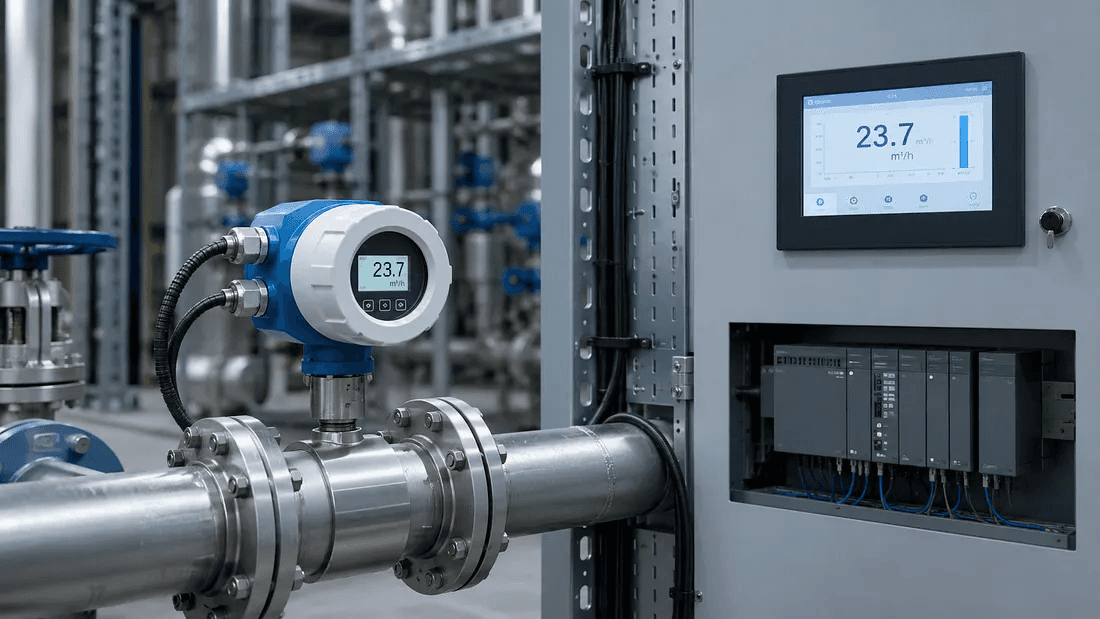
A flowmeter can be mechanically suitable and still create project trouble if the signal path is not clear. The site may know the fluid, pipe size, pressure, temperature and meter type, but if the PLC or DCS cannot receive the reading in the required format, the plant does not have usable measurement yet. The signal is not an accessory. It is part of the instrument configuration.
This issue often appears too late. The quotation is accepted, the meter is prepared and startup approaches. Then someone asks how the control system will read the number. That question should be answered at the beginning because it can affect transmitter choice, wiring, power supply, display arrangement and commissioning plan.
What should be confirmed before startup?
Confirm the required output type. Many industrial projects discuss 4-20 mA, pulse, RS485, HART, Modbus or other available options depending on the selected product family and configuration. The exact output should not be assumed from a general product name. It should be written into the inquiry and confirmed before order.
Confirm how the reading will be used. A local display for operator checking is different from a signal used for control, batching, reporting or energy monitoring. Confirm whether total flow, instantaneous flow, temperature, pressure or compensated values are needed. Confirm whether the plant needs remote display, battery power, loop power or a specific communication interface.
Display, power and protocol considerations
Display location can matter on a real site. A meter installed high on a pipe rack may need remote display. A buried or difficult access line may require a different arrangement. A utility metering point may need the reading sent to a monitoring system instead of relying on local checking. These choices should be discussed before the enclosure, transmitter or wiring plan is fixed.
Power supply should also be reviewed. Some sites have easy access to power, while others need battery or low-power configurations where available. Communication protocol should match the receiving system. If the plant expects Modbus, HART or RS485, state that clearly. If the plant only needs 4-20 mA and pulse, say that too. Clear signal requirements reduce commissioning confusion.
How signal questions connect to meter type
Different meter families can support different output arrangements depending on configuration. Vortex, electromagnetic, thermal mass, turbine and other Velomac product families should be reviewed with output needs in mind. A buyer should not assume that every meter family will provide the same signal package in the same way.
The process condition still comes first. Steam, gas, conductive liquid, compressed air, clean liquid and chemical media guide the meter family. Once the meter direction is clear, the signal direction should be confirmed. This creates a complete recommendation: measurement principle, body configuration, material direction and output path.
Commissioning context and reading confidence
Commissioning is where the plant first sees whether the meter and control system agree. If the signal scaling, unit, pulse factor, communication setting or display expectation is unclear, the startup team may lose time solving a problem that should have been prevented in the inquiry stage. This is why signal details belong in the first technical conversation.
Reading confidence also depends on the process information behind the selected meter. Flow range, pressure, temperature and installation details should be reviewed together with signal output. A clean signal from a poorly selected meter is not enough. A suitable meter with an unclear signal path is also not enough. Both sides matter.
What to send before quotation
Send the fluid, pipe size, flow range, pressure, temperature, installation details and required output signal. Add the receiving system name if available, such as PLC, DCS, recorder or energy monitoring platform. State whether the reading is used for local display, process control, alarm, batching, reporting or utility review.
For retrofit projects, include photos of the meter location and cable route if possible. For remote display needs, explain where the display should be placed. Velomac can then review the meter configuration and signal output together, so the project is not treated as complete before the control system can read the number.
Questions for the automation or electrical team
Before ordering, ask the automation or electrical team what signal the system expects, where the cable will run, what power is available and whether the value needs scaling in the PLC or DCS. Ask whether the system needs instantaneous flow, totalized flow, alarm output or communication data. If the project has a standard instrument list, compare the flowmeter configuration against that list.
This step is simple, but it prevents late confusion. It also helps Velomac confirm whether the selected product family can support the required output in the requested configuration. The mechanical and electrical parts of the project should be reviewed together.