
Quick Answer: What Counts as a Pass in Flowmeter Sample Testing?
A flowmeter sample passes when its measurement error and repeatability meet the acceptance limits agreed before testing, at each specified flow point, under documented test-loop conditions.
The evaluation must identify the reference method, test medium, operating range, installation arrangement and sample configuration. The sample serial number and approved technical specifications then provide the baseline for subsequent production orders.
The pass criteria are project-specific. IEC 62828-5:2020 establishes test procedures for industrial flow transmitters and provides a framework for acceptance testing. It specifies that acceptance tests are typically defined and agreed between the manufacturer and the user.
This means the buyer and manufacturer should establish the allowable measurement error, repeatability requirements and test procedure before the sample enters the test loop.
Why Flowmeter Sample Testing Matters Before Supplier Approval
For an overseas distributor, independent laboratory or engineering company, purchasing a sample is often an important step before adding a new manufacturer to an approved supplier list.
The buyer may already have reviewed product specifications, technical drawings and calibration documents. Testing a sample on an independent test loop provides additional evidence about the actual measurement behaviour under the selected conditions.
However, a successful sample evaluation should establish more than a comparison between two displayed readings.
The buyer also needs to understand:
Configuration: Does the tested sample match the specification intended for future orders?
Measurement: Does the sample meet the agreed error and repeatability limits?
Test conditions: Can the test loop provide suitable and stable measurement conditions?
Documentation: Can the test results be traced to the specific sample?
Production consistency: Can the approved configuration be maintained for subsequent production orders?
These questions connect sample testing with supplier qualification and long-term purchasing decisions.
Six Areas to Agree Before Flowmeter Sample Testing
Before the sample arrives at the laboratory or test facility, the buyer and manufacturer should establish a common test plan.
3.1 Sample Configuration
The sample should have a clearly documented technical configuration.
Important information includes:
Flowmeter model and measurement principle.
Nominal diameter (DN).
Body material.
Liner material, where applicable.
Electrode material, where applicable.
Flange standard and pressure rating.
Power supply and output signals.
Display and specified accessories.
Relevant configuration or drawing revision.
The sample's serial number and approved technical specification should be recorded before testing.
This creates an identifiable reference for the evaluation and subsequent production orders.
3.2 Operating Conditions
The test conditions should reflect the intended application as closely as the test facility allows.
Confirm:
Measurement medium and fluid phase.
Minimum operating flow.
Normal operating flow.
Maximum operating flow.
Operating temperature.
Operating pressure.
Relevant fluid properties, such as density, viscosity and conductivity.
Testing at one flow point establishes evidence for that particular condition.
Where the application requires a wider operating range, the test plan should cover the relevant flow points.
When the test medium differs from the actual process fluid, the buyer and manufacturer should assess how differences in fluid properties affect the results.
For example, a water test may support the evaluation of a liquid flowmeter, while a different process liquid may introduce changes in viscosity, density or conductivity that require additional consideration.
3.3 Installation and Test-Loop Conditions
The test loop itself can influence measurement results.
Both parties should review:
Test pipe diameter and internal dimensions.
Upstream and downstream straight pipe lengths.
Flow direction and installation orientation.
Reference meter position.
Test-loop arrangement.
Flow stability.
Pipe connections and potential leakage.
Vibration and other external influences.
The required straight-run lengths should follow the selected meter's installation requirements.
For liquid testing, the measuring section should remain completely filled, with suitable arrangements for removing trapped air or gas.
IEC 62828-5:2020 specifically discusses installation conditions, air bleeding, vibration, leakage and the influence of fluid properties such as density, viscosity and conductivity.
It also requires suitable measurement stability during testing. When the test conditions fall outside the applicable stability requirements, the affected measurement should be repeated after the conditions are restored.
3.4 Reference Instrument and Measurement Method
A meaningful comparison requires an agreed reference.
The buyer and manufacturer should identify:
Reference instrument model and serial number.
Reference instrument calibration status.
Measurement range.
Measurement uncertainty.
Traceability information.
Test method and data collection procedure.
The reference system should measure the same quantity as the sample.
For example, when comparing mass flow with volumetric flow, the necessary density information and conversion method should be documented.
Traceability and measurement uncertainty should both be reviewed. Traceability identifies the measurement's connection to higher-level standards, while uncertainty describes the range associated with the measurement result.
UNIDO's Guidelines on Calibration of Flow Meters discusses these requirements and the importance of including reference-system uncertainty in calibration results.
IEC 62828-5:2020 also describes comparison against a reference meter and discusses primary methods such as gravimetric, pressure-based and volume-based references for situations requiring higher measurement capability.
3.5 Test Points and Data Collection
Before testing, agree on the flow points and the measurement procedure.
A typical evaluation may include:
Test point ------------ What to evaluate
Minimum flow --------- Measurement behaviour at the lower operating point
Normal flow ------------ Measurement result under the typical operating condition
Maximum flow --------- Measurement behaviour at the upper operating point
Additional points ------ Other specified conditions required by the buyer
At each test point, record:
Sample flow indication.
Reference flow value.
Measurement error.
Repeated readings.
Flow stability.
Relevant temperature and pressure.
Output signal, where included in the test scope.
Allow sufficient stabilization time before recording each measurement.
The recording duration should also be suitable for the meter's response characteristics and the resolution of the measuring equipment.
3.6 Acceptance Criteria
This is one of the most important parts of the entire evaluation.
Before testing starts, define the actual pass/fail requirements.
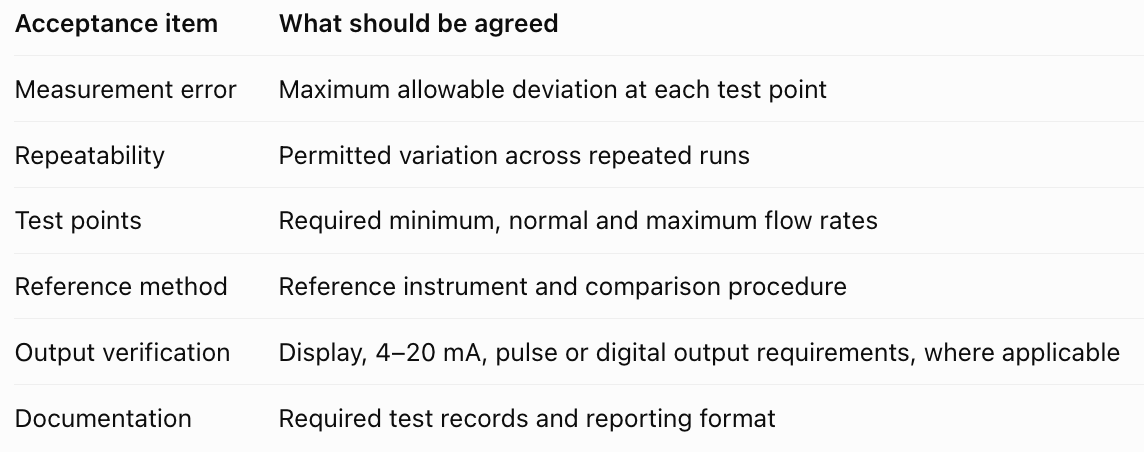
For example, if the buyer requires a specified maximum error at minimum, normal and maximum flow, those limits should be written into the test agreement before the first test.
Both parties should also agree on the decision process when a measurement falls outside the specified limits.
Possible outcomes include:
Pass: all agreed acceptance criteria are met.
Fail: a valid test demonstrates that one or more acceptance criteria have been missed.
Inconclusive: the reference system or test conditions require further review before a final decision.
The test procedure and decision rules should be agreed before the sample is tested.
How to Evaluate the Sample Test Results
Once the test is complete, the buyer needs a consistent method to evaluate the results.
Two important indicators are measurement error and repeatability.
Measurement Error
Measurement error describes the difference between the sample indication and the reference value.
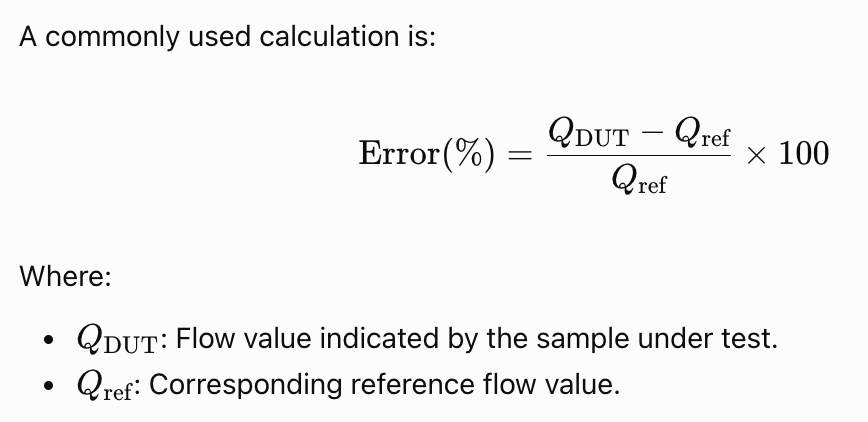
Both values should use the same measurement basis and relevant reference conditions.
Any required temperature or pressure corrections should be applied or included in the measurement uncertainty assessment.
Repeatability
Repeatability describes how closely repeated measurements agree under the same test conditions.
For example, the buyer may repeat measurements at the same flow point and compare the recorded results.
The test report should show the repeated readings and their variation against the agreed repeatability limit.
A single reading provides evidence of one measurement result. Repeated runs provide additional information about the consistency of the readings.
Consider the Test Bench Uncertainty
The reference system and test bench also contribute to the overall uncertainty of the evaluation.
If the test bench uncertainty is too large relative to the buyer's acceptance limit, the result may be insufficient to establish a clear pass or fail.
Therefore, the test bench's measurement uncertainty should be reviewed alongside the meter's specified error limit.
UNIDO's calibration guidelines explain how reference uncertainty, instrument resolution, repeatability and other influence factors contribute to the uncertainty of a calibration result.
A Sample Passed the Test. Does That Mean the Production Order Is Ready?
A successful test is an important milestone, while production approval involves an additional consideration: consistency between the tested sample and the products supplied later.
Consider two separate approval stages.
Stage 1 — Sample Acceptance
The buyer confirms that the tested sample meets the agreed technical and measurement requirements.
The relevant records should include:
Sample serial number.
Approved technical datasheet.
Test conditions.
Reference instrument information.
Test results and acceptance decision.
Stage 2 — Production Approval
The buyer confirms that the approved configuration and manufacturing requirements will be maintained for subsequent orders.
The production reference may include:
Approved model and technical specifications.
Body and wetted material requirements.
Sensor and electronic configuration.
Connection dimensions and standards.
Calibration and inspection requirements.
Procedures for reviewing configuration changes.
If a subsequent production batch involves changes to an approved material, component or configuration, the change should be documented and reviewed against the original approval.
A sample approval establishes a reference configuration for future production. Batch inspection and routine production testing can be defined as separate purchasing requirements.
This creates a clearer connection between sample evaluation and long-term supplier qualification.
Calibration, Verification and Acceptance Testing: Understanding the Difference
These terms are often discussed during supplier evaluation, but they describe different measurement activities.
Calibration
Calibration establishes the relationship between an instrument's indication and a reference measurement under specified conditions.
The calibration result should identify the method, reference system, relevant conditions and measurement uncertainty.
Verification
Verification checks whether an instrument meets defined requirements or remains within an established tolerance.
In-Field Proving
In-field proving evaluates the meter within a particular installed system to establish confidence in its measurement under actual operating conditions.
Acceptance Testing
Acceptance testing evaluates whether the sample or equipment meets the requirements agreed between the buyer and manufacturer.
UNIDO's Guidelines on Calibration of Flow Meters distinguishes calibration, verification and in-field proving according to their respective purposes.
A customer test-loop comparison can serve as an acceptance test. It qualifies as a calibration when the procedure, reference traceability, uncertainty assessment and reporting meet the applicable calibration requirements.
Buyers should clarify which type of evidence they require before arranging the sample test.
Which Velomac Products May Be Relevant?
The sample evaluation approach can be applied across different industrial flow measurement applications.
Depending on the medium, operating conditions and test-loop capabilities, relevant Velomac products may include:
Vortex Flowmeter
Suitable for specified gas, steam and liquid applications. Sample testing should consider the operating flow range, temperature, pressure, installation conditions and flow stability.
Liquid Turbine Flowmeter
For suitable clean-liquid applications. The test plan should consider fluid viscosity, flow range and the operating conditions specified for the meter.
Electromagnetic Flowmeter
For conductive liquid applications. Fluid conductivity and full-pipe installation should be confirmed before testing.
Ultrasonic Flowmeter
For suitable liquid applications, with test conditions depending on the measurement arrangement. For clamp-on configurations, pipe material, outer diameter, wall thickness, lining and sensor installation should be reviewed.
Each measurement principle requires its own installation review and acceptance criteria.
A shared test loop can evaluate different meter technologies, while each sample still requires a technology-specific test procedure.
What Velomac Can Provide During Sample Evaluation
Velomac Flow Meter combines in-house manufacturing and calibration capabilities to support technical discussions before and after sample testing.
Our manufacturing processes include:
CNC machining.
Welding.
Instrument assembly.
In-house liquid calibration facilities.
In-house gas calibration facilities.
For an agreed sample evaluation project, the following information can be discussed and prepared according to the project scope:
Sample technical configuration and identification.
Relevant calibration or test records.
Test conditions and measurement points.
Reference measurement and acceptance requirements.
Correspondence between the approved sample and subsequent production configuration.
Sample availability, testing arrangements, associated costs and delivery schedules are confirmed individually according to project requirements.
The objective is to establish a documented technical basis for both sample approval and subsequent purchasing decisions.
Practical Checklist: Before Approving a Flowmeter Sample
Use this checklist before sending a sample for independent testing.
Confirm the model, DN, materials and connection specifications.
Record the sample serial number and approved configuration.
Define the measurement medium and actual operating conditions.
Confirm minimum, normal and maximum flow requirements.
Review test-loop pipe dimensions and straight-run requirements.
Identify the reference instrument and its calibration status.
Review the reference system's measurement uncertainty.
Agree on test points, allowable error and repeatability limits.
Define the test procedure and required documentation.
Establish how the approved configuration will be maintained in future production.
The key principle: Agree on the test conditions and acceptance criteria before the sample enters the test loop.
Common Questions About Flowmeter Sample Testing
Q1. What exactly counts as a successful flowmeter sample test?
A sample passes when its measurement error and repeatability meet the agreed acceptance limits at all specified test points under documented conditions. The reference method and test results should also be recorded.
Q2. Does IEC 62828-5:2020 specify a universal pass/fail tolerance?
The standard establishes testing procedures for industrial flow transmitters. Specific acceptance limits are agreed between the manufacturer and user according to the instrument requirements and test conditions.
Q3. Can a sample tested with water represent a different process liquid?
A water test establishes evidence under the specified water conditions. For another liquid, the buyer should assess differences in density, viscosity and other relevant fluid properties before applying the test result to the intended application.
Q4. Is a test-loop report the same as a calibration certificate?
They serve different purposes. An acceptance test report documents whether the sample meets agreed requirements. A calibration report documents the comparison against a reference under specified conditions, including relevant measurement uncertainty and traceability information.
Q5. Does passing a sample test approve all future production units?
Sample approval establishes the approved configuration and its test results as a production reference. Subsequent orders should follow the agreed technical specifications, manufacturing requirements and inspection arrangements.
From Sample Evaluation to Supplier Approval
A flowmeter sample test should establish more than a successful reading. It should give both parties an agreed technical reference for future purchasing and production.
Velomac Flow Meter provides manufacturer-direct application review, in-house production and liquid and gas calibration support.
If your team is evaluating a flowmeter sample, share your test-loop conditions, technical requirements and acceptance criteria with us. We can discuss the sample configuration and testing arrangements before proceeding.
Technical References
IEC 62828-5:2020 — Reference Conditions and Procedures for Testing Industrial and Process Measurement Transmitters, Part 5.
UNIDO — Guidelines on Calibration of Flow Meters