
Fertilizer Plant Flow Measurement: What Do the Announced Capacities Tell Us?
On 4 November 2026, Daewoo Engineering & Construction announced that it had received a Letter of Award (LOA) from IF FZE, Indorama's Nigerian subsidiary, for the Indorama Fertilizer Train 4 Project in Port Harcourt, Rivers State, Nigeria.
The project carries an announced contract value of approximately KRW 350 billion and includes the following production capacities:
Production Unit | Announced Capacity |
|---|---|
Ammonia | 2,300 t/day |
Urea | 4,000 t/day |
Urea crystals | 4,000 t/day |
View original table image: Announced production capacities
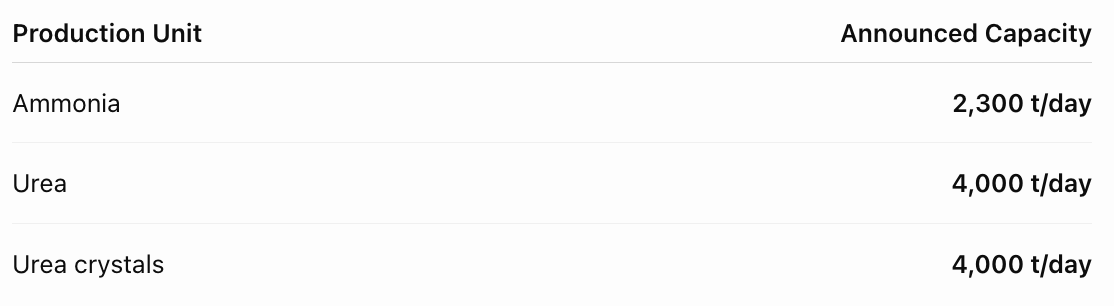
These figures describe the announced capacities of different production units within the project.
The LOA represents a new project award milestone. The announcement does not establish that the fourth unit has entered operation.
The key engineering distinction is that production capacity and individual pipeline flow are different quantities.
For this project, 2,300 t/day represents the announced ammonia production capacity, while 4,000 t/day represents the announced urea production capacity. Another 4,000 t/day is separately listed for urea crystals.
The two 4,000 t/day figures should remain separately identified until the approved process flow diagram (PFD) confirms their relationship. They should not be added together to calculate total final product output.
For flowmeter selection, engineers need the actual operating flow at each measurement point, including minimum, normal and maximum rates, medium composition, physical state, pressure and temperature.
A plant-wide production figure provides project context. The individual process stream defines the flowmeter duty.
Ammonia-to-Urea Mass Balance: What Does the Calculation Tell Us?
The chemical relationship between ammonia and urea provides an initial reference for understanding the announced production capacities.
The overall urea synthesis reaction is:
2NH₃ + CO₂ → CO(NH₂)₂ + H₂O
Based on the theoretical molecular relationship:
Approximately 0.567 tonnes of ammonia are consumed per tonne of urea.
Approximately 0.733 tonnes of CO₂ are consumed per tonne of urea.
For a theoretical urea production rate of 4,000 t/day:
Material | Theoretical Requirement |
|---|---|
Ammonia (NH₃) | Approximately 2,270 t/day |
Carbon dioxide (CO₂) | Approximately 2,930 t/day |
Urea | 4,000 t/day |
View original table image: Theoretical material requirements
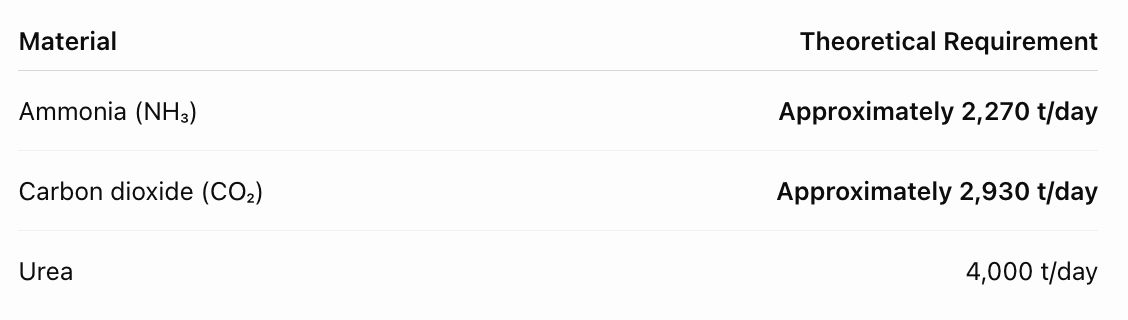
The ammonia calculation is:
4,000 × 0.567 ≈ 2,268 t/day
The CO₂ calculation is:
4,000 × 0.733 ≈ 2,931 t/day
The theoretical ammonia requirement is numerically close to the announced ammonia production capacity of 2,300 t/day.
This provides an interesting preliminary material-balance reference for the project.
However, stoichiometric consumption is a theoretical reaction requirement, while actual pipeline flow depends on the process design and operating conditions.
The final plant material balance must account for:
Ammonia recovery and recycle.
CO₂ recovery and supply arrangements.
Process circulation.
Operating load and production rate.
Process losses and other consumption points.
Startup and shutdown conditions.
For instrumentation engineers, this distinction is important when reviewing fresh-feed measurement, recycle measurement and internal process circulation.
Where Does Flow Measurement Become Important in a Fertilizer Plant?
A large ammonia and urea production facility involves multiple interconnected process streams and utility systems.
Each measurement point has its own process purpose and operating conditions.
Measurement Area | Measurement Objective | Key Engineering Considerations |
|---|---|---|
Natural gas feed | Monitor gas supplied to the ammonia production section | Gas composition, pressure, temperature and reference conditions |
Ammonia feed | Measure ammonia entering the synthesis process | Physical state, pressure, temperature and material compatibility |
CO₂ feed | Monitor CO₂ entering urea synthesis | Gas composition, mass flow and operating conditions |
Recycle streams | Monitor internal process circulation | Flow direction, recycle boundaries and operating range |
Urea solution or melt | Monitor liquid transfer between process stages | Concentration, temperature, viscosity and crystallization conditions |
Process condensate | Monitor recovered liquid and water balance | Conductivity, temperature and pipe conditions |
Cooling water | Measure utility supply and return flows | Conductivity, flow range and installation conditions |
Steam utilities | Monitor steam distribution to production units | Steam condition, pressure, temperature and operating flow |
View original table image: Fertilizer plant flow measurement points
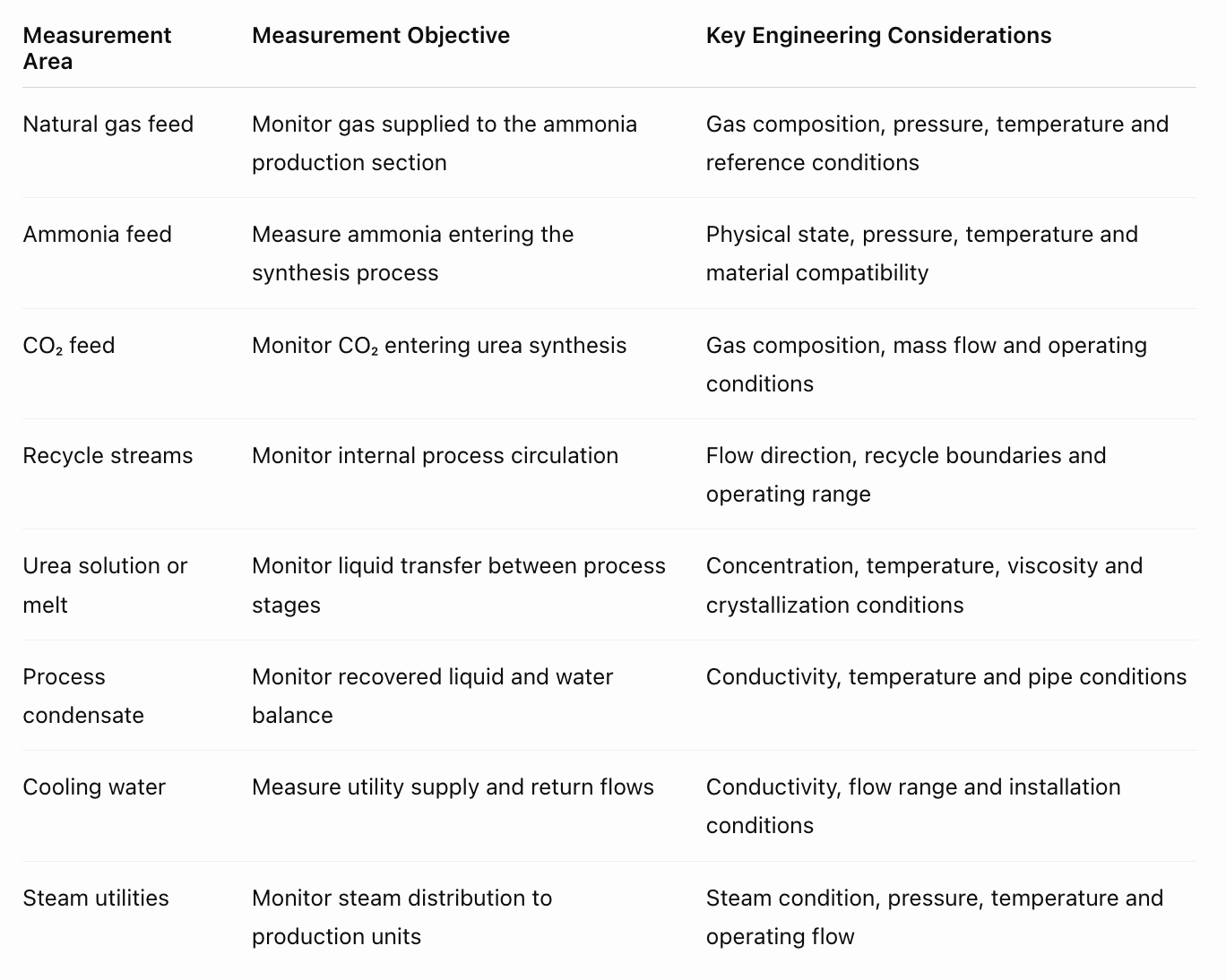
One important consideration is the distinction between fresh-feed flow and internal recycle flow.
A process line carrying recycled material may have a substantial flow rate even when the final product output remains unchanged.
Similarly, gas measurement requires a clearly defined measurement basis.
For example, actual volumetric flow and normalized volumetric flow describe different conditions. Engineers should establish the reference temperature and pressure when a gas flow rate is specified in Nm³/h or another standardized unit.
This information is essential when translating process requirements into flowmeter specifications.
What Should Engineers Check Before Flowmeter Selection?
Once the measurement boundaries have been identified, instrumentation engineers should review the actual operating conditions of each pipeline.
A. Medium and Physical State
Identify the exact medium and its composition.
For chemical process applications, review:
Chemical composition and concentration.
Gas, liquid or multiphase condition.
Conductivity for liquid applications.
Density and viscosity.
Suspended solids or entrained gas.
Corrosion and material compatibility.
Potential crystallization or solidification.
The physical state of the medium directly influences instrument selection and construction requirements.
B. Operating Pressure and Temperature
Prepare both normal and maximum operating conditions.
For each measurement point, confirm:
Normal operating pressure.
Maximum operating pressure.
Normal operating temperature.
Maximum operating temperature.
Expected pressure and temperature variations.
These values help determine the required instrument construction, connection rating and suitability for the actual process environment.
C. Minimum, Normal and Maximum Flow
Prepare the complete operating flow range.
ParameterEngineering PurposeMinimum FlowDefines the lowest expected operating conditionNormal FlowRepresents the usual operating conditionMaximum FlowDefines the upper operating requirement
Flowmeter sizing should start with the actual minimum and maximum operating flow, rather than the plant's announced daily production capacity.
The expected operating turndown should also be reviewed against the selected instrument's actual measurement range.
D. Pipeline and Installation Conditions
Prepare the following information:
Nominal pipe diameter (DN).
Pipe material and wall thickness.
Flange standard and pressure rating.
Available upstream and downstream straight lengths.
Installation orientation.
Vibration and surrounding equipment.
Available maintenance space.
Environmental and enclosure requirements.
For large industrial installations, access for maintenance and future inspection should also be considered during instrument layout.
E. Signal and Control Requirements
Confirm the instrumentation requirements before procurement.
Typical information includes:
4–20 mA output.
RS485 communication.
Modbus or HART requirements, where applicable.
PLC/DCS integration.
Power supply.
Local display and remote monitoring.
Required alarm and diagnostic information.
Defining these details early helps engineering, procurement and automation teams work from the same instrument specification.
Which Velomac Products May Be Relevant to Fertilizer Plant Utilities?
For large fertilizer projects, Velomac's clearest potential applications are associated with suitable plant utility measurement points.
Product selection should follow the actual medium, operating conditions and installation requirements.
Electromagnetic Flowmeter
For conductive cooling-water and process-water pipelines, an Electromagnetic Flowmeter may be considered.
The application review should cover:
Liquid conductivity.
Full-pipe operating conditions.
Liner and electrode material compatibility.
Operating temperature and pressure.
Pipeline size.
Installation arrangement.
The actual water characteristics determine instrument suitability.
Vortex Flowmeter
For suitable steam utility applications, a Vortex Flowmeter may be evaluated.
Important selection considerations include:
Minimum, normal and maximum steam flow.
Operating pressure and temperature.
Steam condition.
Pipe diameter.
Straight-run requirements.
Vibration and installation environment.
For ammonia, CO₂ and urea main-process lines, a separate engineering assessment is required before recommending any instrument.
The review should establish the actual fluid phase, chemical compatibility, pressure, temperature, concentration and potential crystallization conditions.
A product recommendation should follow a confirmed measurement requirement, rather than the name of the production unit alone.
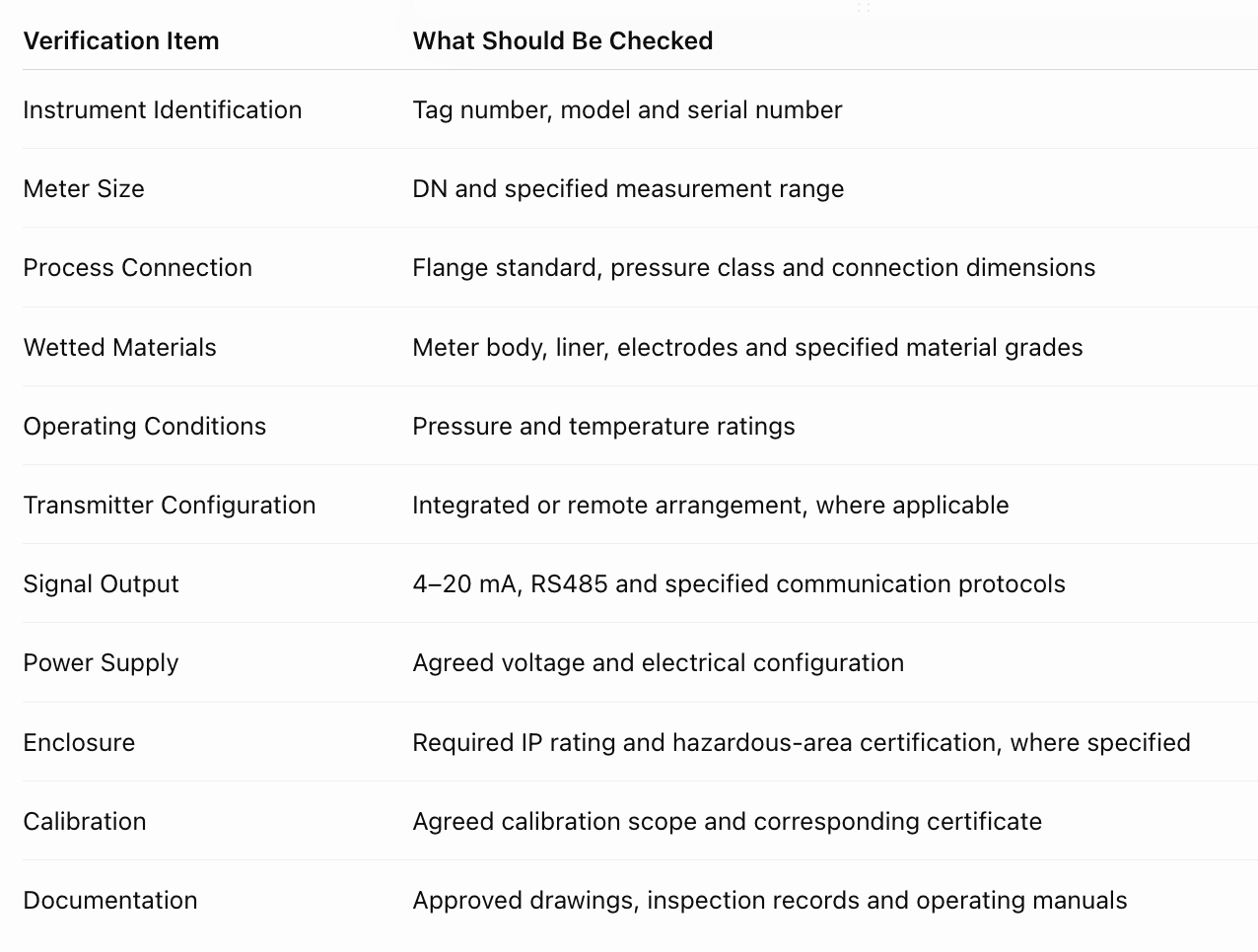
Before Manufacturing: Does the Instrument Match the Approved Specification?
For overseas EPC contractors and purchasing teams, technical approval is only one stage of equipment procurement.
Another important question is whether the instrument being manufactured matches the approved datasheet and purchase order.
Before production or final inspection, buyers should align the following information:
Verification Item | What Should Be Checked |
|---|---|
Instrument Identification | Tag number, model and serial number |
Meter Size | DN and specified measurement range |
Process Connection | Flange standard, pressure class and connection dimensions |
Wetted Materials | Meter body, liner, electrodes and specified material grades |
Operating Conditions | Pressure and temperature ratings |
Transmitter Configuration | Integrated or remote arrangement, where applicable |
Signal Output | 4–20 mA, RS485 and specified communication protocols |
Power Supply | Agreed voltage and electrical configuration |
Enclosure | Required IP rating and hazardous-area certification, where specified |
Calibration | Agreed calibration scope and corresponding certificate |
Documentation | Approved drawings, inspection records and operating manuals |
View original table image: Instrument verification before shipment
What Should Be Included in Factory Inspection?
Depending on the purchase order and inspection plan, the agreed factory inspection may include:
Instrument identification and configuration verification.
Dimensional and visual inspection.
Material documentation for specified components.
Electrical and output checks.
Calibration results.
Factory Acceptance Test (FAT) records, where required.
Calibration certificates and inspection records should be traceable to the relevant instrument identification or serial number.
For EPC projects, the inspection scope and acceptance criteria should be agreed before production completion.
This gives the buyer a clear reference for checking the supplied instrument against the approved technical documents.
From Factory to Project Site: What Should Buyers Check for Sea Freight?
For overseas industrial projects, the journey from the manufacturer's factory to the installation site introduces another set of considerations.
A flowmeter may travel through factory handling, inland transportation, port storage, container loading, sea transportation and destination handling before reaching the project site.
During longer sea journeys, temperature variations and internal container humidity can create condensation, sometimes referred to as container sweat.
The IMO/ILO/UNECE Code of Practice for Packing of Cargo Transport Units (CTU Code) addresses cargo protection, securing arrangements and condensation-related damage during transportation.
For industrial instrumentation, several areas deserve attention.
A. Moisture and Corrosion Protection
Electrical and mechanical components require suitable protection during transportation and storage.
Before packing, buyers should confirm:
Instruments are dry and prepared for the agreed storage conditions.
Flange faces and process connections have suitable protective covers.
Exposed electrical connections and cable entries are protected.
Suitable moisture barriers or desiccants are selected according to the route, packing design and storage duration.
Corrosion protection is appropriate for the instrument materials and transportation environment.
Moisture protection should be considered as part of the complete packaging design, rather than relying on the external wooden crate alone.
B. Mechanical Protection During Transportation
Industrial flowmeters can have different dimensions, weights and structural configurations.
Packaging should account for the instrument's actual construction.
Important checks include:
Suitable support for the meter body.
Protection for the sensor and transmitter.
Secure positioning of detachable components.
Internal blocking and bracing to prevent movement.
Appropriate load distribution.
Clearly identified lifting points and package orientation.
For large-diameter and heavy flowmeters, the centre of gravity, lifting arrangement and weight distribution should be reviewed before dispatch.
The packaging and securing arrangement should protect the equipment while accommodating normal transportation and handling loads.
C. Export Wooden Packaging and ISPM 15
International shipments using solid-wood packaging may be subject to phytosanitary requirements.
The International Standard for Phytosanitary Measures No. 15 (ISPM 15) addresses the treatment and marking of raw-wood packaging materials used in international trade.
This can include:
Wooden pallets.
Solid-wood crates.
Dunnage.
Wooden packing blocks.
Other applicable solid-wood packaging components.
When solid-wood packaging is used, buyers should confirm the applicable destination-country requirements and the corresponding ISPM 15 treatment and marking.
Processed wood products such as plywood are outside the scope of ISPM 15 as described by the IPPC standard.
D. Packaging Identification and Shipment Records
Each export package should have clear identification corresponding to the shipment documentation.
Recommended information includes:
Package number.
Instrument model and tag reference.
Package dimensions.
Gross and net weight.
Handling and lifting instructions.
Applicable storage and orientation markings.
For multi-instrument orders, package identification should be traceable to the packing list and corresponding instrument records.
This makes receiving inspection easier for overseas warehouse and project teams.
What Documents Should Accompany an Industrial Flowmeter Shipment?
Documentation is another important part of international equipment procurement.
For an EPC contractor or overseas buyer, the delivered equipment should be traceable to the approved technical specification, inspection records and agreed commercial scope.
Depending on the purchase order and destination requirements, the shipment documentation may include:
Document | What Buyers Should Verify |
|---|---|
Commercial Invoice | Product description, quantity, agreed value and currency |
Packing List | Package count, dimensions, gross/net weight and instrument identification |
Bill of Lading (B/L) | Shipment information, consignee and transportation details |
Certificate of Origin | Country of origin information, where required |
Calibration Certificate | Instrument identification and corresponding calibration results |
Material Test Report (MTR) | Specified material information for applicable components |
Inspection Records | Agreed factory inspection and verification results |
FAT Records | Test results and acceptance records, where required |
Product Manuals | Installation, configuration and operating instructions |
Technical Drawings | Connection dimensions, wiring and installation references |
Insurance Certificate | Shipment insurance information, where insurance is arranged |
View original table image: Shipment documents for buyer verification
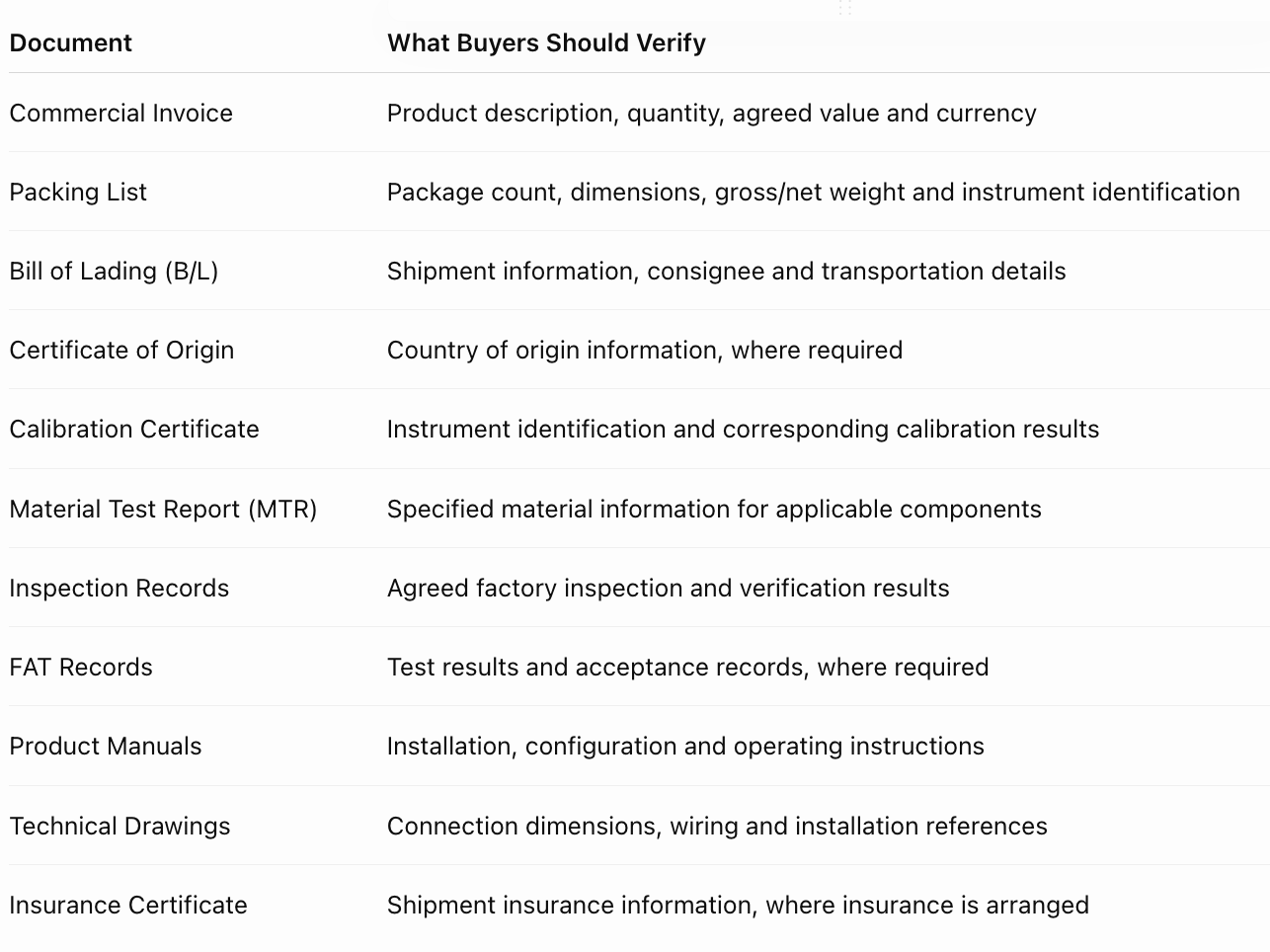
The document package should be agreed before shipment, with each required record linked to the relevant instrument or order reference.
For example, a calibration certificate should identify the instrument it covers. A material report should correspond to the material requirements specified in the purchase order.
This makes document review easier during receiving inspection and project handover.
Freight, Insurance and Incoterms: What Should Buyers Clarify?
International quotations can contain several different cost and delivery responsibilities.
For overseas purchasing teams, comparing the instrument price alone may give an incomplete picture of the total procurement scope.
Before confirming an order, the buyer and supplier should agree on the following:
A. Incoterms and Named Destination
Specify the agreed Incoterms rule, the named port or place and the applicable version.
For example:
[Agreed Incoterms Rule] + [Named Port or Place] + Incoterms® 2020
The named location is important because Incoterms allocate delivery obligations, transportation responsibilities, costs and risk-transfer points between seller and buyer.
B. International Freight
Confirm:
Transportation mode.
Port of loading.
Destination port.
Freight arrangement.
Estimated transportation scope.
Responsibility for origin-side handling.
C. Cargo Insurance
Clarify:
Whether cargo insurance is included.
Which party arranges the insurance.
Coverage scope and insured value.
Applicable claim procedures.
Insurance responsibilities vary according to the selected Incoterms rule and the agreed commercial arrangement.
D. Destination Charges and Final Delivery
Confirm responsibility for:
Destination terminal charges.
Import customs clearance.
Customs duties and applicable taxes.
Port handling.
Inland transportation.
Final delivery to the project site.
Unloading arrangements.
A clear quotation should distinguish the instrument price, export packaging, freight, insurance and destination-related charges.
This helps procurement teams compare suppliers based on the actual agreed supply and delivery scope.
What Should Buyers Check When the Shipment Arrives?
The receiving inspection connects factory verification with final site acceptance.
After the shipment reaches the destination, the receiving team should complete an initial inspection before the instruments move into storage or installation.
Recommended checks include:
Compare the package count against the packing list.
Inspect the external packaging for visible damage.
Check package identification and shipping marks.
Record any damaged crates or signs of moisture.
Verify instrument model, tag number and serial number.
Check supplied accessories against the purchase order.
Review calibration certificates and agreed inspection documents.
Record and report transportation damage promptly to the relevant carrier or insurer.
For equipment awaiting installation, follow the manufacturer's storage instructions and maintain suitable environmental protection.
Photographs and receiving inspection records provide a clear reference when investigating transportation damage or shipment discrepancies.
How Can a Manufacturer Build Buyer Confidence Before Dispatch?
For overseas buyers working with a new manufacturer, confidence comes from being able to verify what is actually being supplied.
The manufacturer's role extends beyond confirming the instrument model and quotation.
Buyers should be able to review:
The approved instrument configuration.
The actual instrument identification.
Agreed manufacturing and inspection records.
Calibration documentation.
Material documentation, where specified.
Export packaging arrangements.
Shipment identification and document scope.
Delivery responsibilities under the agreed Incoterms.
For Velomac, this process starts with manufacturer-direct application review and instrument selection.
Our in-house calibration capability provides an additional reference for instrument verification.
Before dispatch, the agreed instrument configuration, calibration records, inspection scope, packaging arrangement and shipment documentation can be clarified with the buyer.
The objective is to connect the approved specification, the manufactured instrument and the delivered equipment through a clear documentation trail.
Practical Checklist: From Flowmeter Selection to International Delivery
For instrumentation engineers, EPC contractors and overseas purchasing teams, the following checklist can help organize the procurement review.
Technical Review
Identify every measurement point on the PFD and P&ID.
Separate production capacity from individual pipeline flow.
Confirm the medium and physical state.
Prepare minimum, normal and maximum flow rates.
Record operating and maximum pressure and temperature.
Confirm gas reference conditions or liquid properties, where applicable.
Check material compatibility and pipeline specifications.
Confirm installation space and straight-run requirements.
Define power supply, output and communication requirements.
Manufacturing and Inspection
Confirm the approved datasheet and revision.
Verify instrument model, tag number and serial number.
Agree on inspection and FAT requirements.
Confirm calibration documentation.
Specify MTR and other material documents where required.
Confirm manuals, drawings and configuration records.
Export and Delivery
Confirm the packaging method for the instrument size and weight.
Check flange, electrical and moisture protection.
Confirm cargo securing and lifting arrangements.
Verify applicable ISPM 15 requirements for solid-wood packaging.
Confirm package identification and packing list.
Agree on Incoterms and the exact named destination.
Clarify freight, insurance and destination charges.
Confirm receiving inspection and damage-reporting arrangements.
Completing these checks before shipment gives technical, procurement and receiving teams a shared reference throughout the equipment supply process.
Common Questions About Fertilizer Plant Flow Measurement and Delivery
Q1. Can the announced ammonia production capacity be used directly for flowmeter sizing?
Ammonia production capacity provides an initial material-balance reference. Flowmeter sizing requires the actual operating flow at the specific pipeline, including minimum, normal and maximum rates, physical state, pressure and temperature.
Q2. How much ammonia is theoretically required to produce 4,000 tonnes of urea per day?
Based on the overall reaction stoichiometry, approximately 2,270 tonnes of ammonia per day are required for 4,000 tonnes of urea. This represents theoretical net chemical consumption. Actual plant feed and circulation rates depend on the process design and operating conditions.
Q3. Should the 4,000 t/day urea capacity and 4,000 t/day urea-crystal capacity be added together?
The two figures should be kept separately identified. Their exact relationship needs to be confirmed through the approved process flow diagram and project scope before calculating total final product output.
Q4. What should buyers check when shipping industrial flowmeters by sea?
Key checks include moisture protection, flange protection, internal cargo securing, lifting arrangements, export packaging and applicable ISPM 15 requirements. The packaging method should account for instrument dimensions, weight, transportation route and storage conditions.
Q5. Which documents should accompany an overseas flowmeter shipment?
Depending on the purchase order and destination requirements, the document package may include a commercial invoice, packing list, Bill of Lading, Certificate of Origin, calibration certificate, material reports, inspection records, manuals and technical drawings.
From Technical Approval to Site Delivery
Large fertilizer projects involve multiple production stages, complex process streams and international equipment procurement.
Successful instrumentation procurement starts with clearly defined measurement requirements and continues through manufacturing verification, calibration, export packaging and receiving inspection.
Velomac provides manufacturer-direct flowmeter support, application review and in-house calibration capabilities.
If your team is reviewing a fertilizer or chemical processing measurement point, share the medium, flow range, pipeline details and operating conditions with Velomac. We can help review the application and clarify the instrument and delivery requirements before ordering.