
Quick Answer
For biomethane grid injection, a reported 900 m³/h becomes a usable grid-delivery figure when the measurement boundary, reference pressure and temperature, and gas-quality acceptance status are defined. Annual delivery also requires actual operating time and totalization records.
For flowmeter selection, engineers should then establish minimum, normal, and peak flow at that same measurement point, together with gas composition, operating pressure, temperature, pipe size, and installation conditions.
Why 900 m³/h Creates a Real Flow Measurement Question
On 15 October 2026, an anaerobic digestion facility in Dorset was officially opened after commissioning earlier in the year.
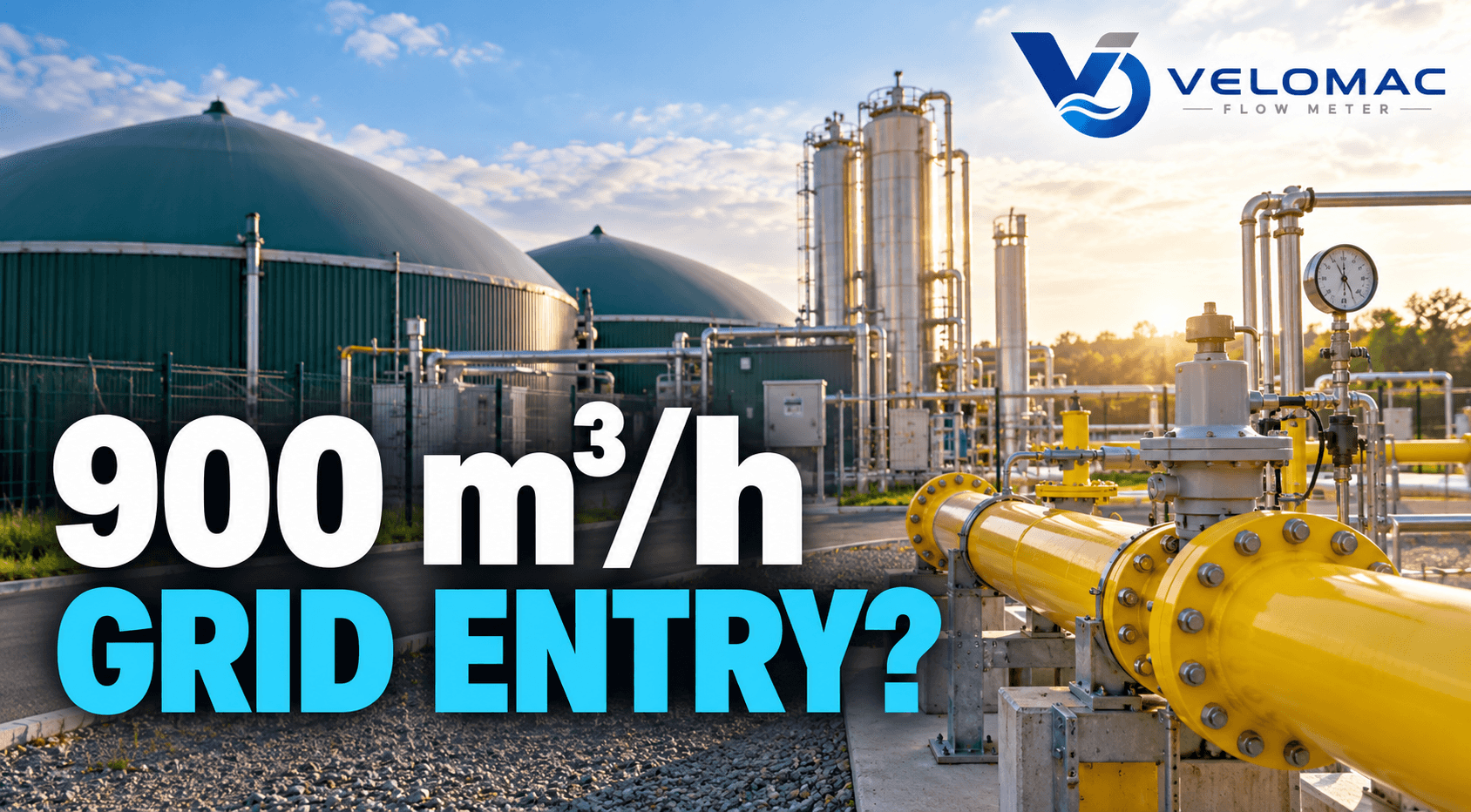
The facility can process more than 50,000 tonnes of food waste annually, while the project announcement states that biomethane is fed directly into the local gas network at 900 m³/h.
The project also describes the plant process as converting food waste into biogas and upgrading it on site to pipeline-quality biomethane.
For an engineering team, 900 m³/h is useful only when the number is connected to a defined measurement point and measurement basis.
A simplified process can be viewed as:
Food Waste → Anaerobic Digestion → Raw Biogas → Gas Upgrading → Gas Conditioning → Grid Entry → Gas Network
Several flow values can exist along that route.
The upgrader output may be useful for process monitoring. The flow at the grid-entry boundary may serve network injection records. A commercial or regulatory quantity may have additional requirements for metering, reference conditions, gas quality, and project approval.
The gas stream is related, but the measurement purpose changes with the boundary.
What Is the Measurement Boundary?
A measurement boundary defines where the measured quantity begins to represent the purpose assigned to it.
For a biomethane project, three boundaries may need to be distinguished:
Upgraded Gas Production
This point represents gas leaving the upgrading process.
It can be useful for monitoring plant output, process efficiency, or upstream operation.
Grid Injection
This point represents biomethane entering the gas network at a defined location.
Pressure control, flow management, gas analysis, and other grid-entry functions may sit around this boundary.
Commercial or Regulatory Measurement
This quantity may be used for commercial records, regulatory calculations, energy accounting, or other formal project purposes.
IGEM/TD/16 describes metering at the Grid Entry Unit as recording the daily quantity of biomethane injected for commercial and regulatory purposes.
A flow value should therefore be connected to both a physical location and a measurement purpose.
That is more informative than asking only whether a flowmeter can measure 900 m³/h.
Gas Quantity and Gas-Quality Acceptance Are Different Functions
Biomethane grid injection brings two related questions together:
How much gas is flowing?
and
Does the gas meet the applicable entry conditions?
They require different measurement functions.
IGEM/TD/16 separates metering from gas analysis. Metering records the injected gas quantity, while gas analysis is used for calorific-value determination and demonstration of compliance with gas-quality requirements.
The same guidance also describes rejection of off-specification gas, typically using a diverter arrangement to prevent that gas from entering the network.
This creates an important engineering distinction:
The flowmeter establishes quantity at its measurement point. Gas-quality instrumentation establishes whether the gas meets the relevant acceptance conditions.
For grid-entry discussions, both belong in the process review, while each serves a separate function.
Why Reference Conditions Matter
Gas volume changes with pressure and temperature.
A figure such as 900 m³/h therefore needs a defined reference basis before different records can be compared.
Project teams should establish whether a flow value represents:
actual volume at line conditions
volume corrected to defined reference conditions
normal operating flow
maximum injection capacity
a design value
a totalized commercial quantity
IGEM/TD/16 states that, unless otherwise specified within the standard, gas volumes are based on real dry gas at 15°C and 1.01325 bar absolute.
That does not establish that the publicly reported 900 m³/h for this particular facility uses the same basis.
The project announcement does not publish enough measurement detail to confirm its reference pressure and temperature.
That distinction matters when a public capacity figure is used for sizing, comparison, or annualization.
For example:
900 m³/h × 24 × 365 = 7.884 million m³/year
This represents a theoretical full-load annual volume if the plant operated continuously at 900 m³/h.
Actual annual delivery depends on real operating hours, actual injected flow, totalization records, plant availability, and the applicable measurement basis.
Build Min / Normal / Peak Before Selecting the Meter
One headline flow rate does not describe the complete operating envelope.
For flowmeter selection, engineers should establish:
Minimum Flow
The lowest meaningful operating flow at the proposed measurement point.
Normal Flow
The range where the process spends most of its operating time.
Peak Flow
The highest expected operating flow under the defined plant condition.
For biomethane gas flow measurement, the review should then add:
gas composition
methane concentration where relevant
operating pressure
operating temperature
pipe size
density information where applicable
compressibility information where applicable
moisture condition
dew point where relevant
upstream equipment
downstream equipment
compression or pressure regulation
available straight pipe
required output and communication
hazardous-area requirements
measurement purpose
Min / Normal / Peak gives the meter an operating envelope. A single 900 m³/h figure gives only one point inside that envelope.
What Information Should Engineers Prepare Before Flowmeter Selection?
A useful gas flowmeter inquiry should connect process information, measurement purpose, and installation conditions.
Process Conditions
Prepare:
gas composition
minimum flow
normal flow
maximum flow
operating pressure
operating temperature
pipe size
moisture or dew-point information where relevant
required actual or referenced volume basis
Measurement Purpose
Define whether the meter is being used for:
process monitoring
upgrader output
grid injection monitoring
totalization
energy accounting
commercial or regulatory measurement
Installation Conditions
Confirm:
connection standard
available straight pipe
upstream fittings
downstream fittings
valves
pressure regulators
compressors
filtration
available installation space
site access
Instrument Requirements
Confirm:
power supply
output signal
communication requirement
local display requirement
totalization requirement
hazardous-area requirement
project documentation requirement
The earlier these items are aligned, the easier it becomes to keep selection, configuration, documentation, and the final delivered instrument consistent.
From Application Review to an Overseas Order
For an overseas buyer, meter selection is one part of a longer project chain.
Once the application has been approved, several details should remain aligned through production and delivery:
Application data → Approved configuration → Tag and nameplate → Output and power → Calibration requirement → Documentation → Packing list → Shipment identification
This becomes particularly important when several instruments are shipped together.
A procurement team should be able to connect the delivered instrument back to the approved measurement point without rebuilding the application history.
For sea freight or other long-distance transport, buyers can also confirm how process connections, exposed instrument parts, cable entries, accessories, identification, and moisture-sensitive areas will be protected during transport.
These checks belong before dispatch, rather than after the crate arrives at site.
The point is wider than packaging:
A technically correct meter still needs its approved configuration, identification, documents, and accessories to arrive together at the correct project location.
How Does This Affect Flowmeter Selection?
Technology should come after the process definition.
For clean, treated biomethane at a suitable internal or plant-side measurement point, the actual flow range, gas composition, pressure, temperature, pipe size, required measurement basis, and installation condition should first be established.
Only then should the meter family be evaluated.
Velomac's current Gas Turbine Flowmeter selection guidance likewise starts from gas composition, minimum / normal / maximum flow, pressure, temperature, pipe layout, and installation conditions.
For Thermal Mass Flowmeter applications, gas type and operating conditions require particular attention because the measurement basis depends on the thermal characteristics of the gas. Velomac's current product guidance therefore calls for final configuration to be reviewed against gas type, flow range, pressure, temperature, and site details.
Which Approved Velomac Products May Be Relevant?
Gas Turbine Flowmeter
A Gas Turbine Flowmeter may be evaluated for compatible clean gas service when the gas composition, operating pressure, temperature, flow range, pipe size, and installation conditions fit the application.
For a biomethane project, the review should establish:
whether the gas condition is suitable
minimum, normal, and maximum flow
actual or referenced volume requirement
operating pressure and temperature
pipe arrangement
filtration and gas cleanliness
required output and totalization
Formal grid-entry or commercial metering requires a separate review of the applicable network, regulatory, calibration, hazardous-area, and project approval requirements.
Covering the nominal 900 m³/h flow range alone does not establish suitability for that formal measurement boundary.
Thermal Mass Flowmeter
A Thermal Mass Flowmeter may be evaluated for suitable internal gas-monitoring applications where the gas composition and measurement basis are sufficiently controlled.
Gas composition deserves particular attention because changes in the gas mixture can affect the relationship between the calibration basis and the process gas.
This makes Thermal Mass Flowmeter more appropriate as a conditional internal process-monitoring direction in this discussion, rather than an assumed grid-entry metering choice.
What Velomac Reviews Before Selection
For a gas flow measurement application, Velomac can review:
medium and gas composition
measurement purpose
measurement location
pipe size
minimum, normal, and maximum flow
operating pressure
operating temperature
installation space
upstream and downstream conditions
connection requirements
required signal output
communication requirements
project specifications
The review starts with what the meter needs to represent at that measurement point, then moves to the appropriate meter configuration.
This manufacturer-direct application review can also clarify missing project information before an order is finalized.
Practical Checklist
Before selecting a flowmeter for a biomethane application, confirm:
What does the reported flow figure represent?
Where is the proposed measurement boundary?
Is the requirement for process monitoring, grid injection monitoring, totalization, or formal commercial measurement?
What are the minimum, normal, and peak flows?
What are the operating pressure and temperature?
What is the gas composition?
What reference pressure and temperature apply to the reported volume?
Are moisture and dew point relevant at the meter location?
Is compression or pressure regulation located nearby?
What pipe size and installation space are available?
What upstream and downstream fittings affect the measurement point?
What output and communication are required?
What hazardous-area requirements apply?
What calibration or project approval requirements apply?
For overseas orders, do the approved specification, tag, nameplate, documentation, accessories, and packing list remain aligned before dispatch?
Common Questions
Is 900 m³/h enough information to select a biomethane flowmeter?
No. A complete selection also requires the measurement purpose, minimum / normal / maximum flow, gas composition, pressure, temperature, pipe size, volume basis, and installation conditions.
The headline flow provides a starting point rather than the complete sizing basis.
What does 900 m³/h mean in a biomethane grid injection project?
It describes a volumetric flow rate, but its engineering meaning depends on where the gas is measured and which reference pressure and temperature apply.
For grid-delivery interpretation, the measurement boundary and applicable gas-quality acceptance conditions should also be defined.
Can 900 m³/h be multiplied by 8,760 hours to calculate annual biomethane delivery?
The calculation gives a theoretical full-load annual volume of 7.884 million m³.
Actual annual delivery requires actual operating time, real flow records, totalization data, and the applicable volume basis.
Can a Gas Turbine Flowmeter be used for biomethane?
A Gas Turbine Flowmeter may be evaluated for compatible clean, treated gas service after confirming gas composition, flow range, pressure, temperature, pipe size, and installation conditions.
Formal grid-entry or commercial measurement requires additional project-specific review and approval.
When may a Thermal Mass Flowmeter be considered?
A Thermal Mass Flowmeter may be evaluated for suitable internal gas-monitoring points where gas composition and the measurement basis are sufficiently controlled.
The expected gas composition should be reviewed before selection.
Start With What the Number Needs to Represent
A biomethane project should begin with a clearer question than:
“Which meter can measure 900 m³/h?”
The stronger application question is:
“What does 900 m³/h need to represent at this measurement point?”
That answer defines the physical boundary, operating envelope, reference conditions, gas-property requirements, and project purpose that should guide the flowmeter review.
Velomac provides manufacturer-direct application review for industrial gas flow measurement. Teams can share the gas composition, pipe size, Min / Normal / Peak flow, pressure, temperature, installation conditions, and signal requirements before selection.